
☀️ Guten Morgen, Berlin!
High: 0.4°C | Low: -1.8°C
Chance of Rain: 100%
Sunrise: 7:56 AM | Sunset: 4:40 PM
Here’s your quick update on what’s happening around the city on Monday, January 26 - from urgent alerts to stories in the subreddit. Today we went through 193 sources so you don't have to.
🚀 Want to reach 3,000+ Berliners? Sponsor an upcoming issue of Berlin News Daily and connect with the city's most engaged audience.
Know someone who’d love this? Share the email or send them the URL. Let's dive in.
🌫️ Air Quality Drops Amid Pollution Spike
Air quality in Berlin and Brandenburg dropped to "very poor" levels this weekend as monitoring stations recorded sharp spikes in fine dust. In Berlin-Neukölln, PM2.5 levels (tiny particles in the air that are 2.5 micrometers or smaller in diameter) reached 57 micrograms per cubic meter (µg/m³), while Potsdam hit 61 µg/m³, far exceeding the World Health Organization's daily guideline of 15 µg/m³. Authorities attribute the hazardous haze to accumulating local and regional emissions. (rbb24)
This pollution is trapped by a high-pressure inversion, where warm air acts as a lid over cold ground air, preventing dispersion. This has driven concentrations particularly in eastern districts where residential heating emissions are high. The stagnant atmosphere allows dangerous particles to stay near the ground rather than mixing into the upper atmosphere. (Tagesspiegel)
Although rain may offer relief, meteorologists warn that winds from the east could keep transporting smog from Poland and the Czech Republic through February. Data indicates that up to two-thirds of the pollution in some eastern cities is imported from foreign coal plants and heating. Experts predict this weather pattern could make next month the worst of the season for regional air quality. (BZ Berlin)
❄️ Black Ice Warnings
The German Weather Service (DWD) issued severe weather warnings for Berlin and Brandenburg as low-pressure system "Leonie" brings dangerous winter conditions. Meteorologists forecast freezing rain and black ice formation beginning Sunday evening, prompting alerts for significant weather risks throughout the region as precipitation hits frozen ground. (Berliner Zeitung)
Precipitation will move northward overnight, striking frozen surfaces with temperatures hovering between -2 and 0 degrees Celsius. Southeastern areas anticipate freezing rain while northern and western sectors are expected to see fresh snow accumulations (from 1 cm to 7 cm) by Monday morning. (Tagesspiegel)
Commuters would face bad travel conditions during the Monday morning rush hour. This weather pattern affects the entire northeast, from Dresden to the Baltic Sea, with sub-freezing temperatures expected to persist through the middle of the week. (Morgenpost)
🚇 Teenager Electrocuted in the U-Bahn
A 17-year-old died early Saturday morning at Berlin's Deutsche Oper U-Bahn station after attempting to retrieve an e-cigarette dropped onto the tracks. According to police, the teenager climbed into the track bed beneath a stationary train to recover the device when he touched a live power rail. He suffered a fatal electric shock and died at the scene. (rbb24)
The city's U-Bahn system utilizes a "third rail" that remains permanently electrified at 750 volts of direct current, significantly higher than the standard 230-volt household supply. On the U2 line, this conductor rail is exposed from above rather than covered. Transit officials confirmed that parked trains draw continuous power for onboard safety systems. (tagesspiegel.de)
Authorities emphasized that passengers must never enter the track area, warning that retrieving lost items like headphones or vapes is not worth the risk. Instead of climbing down, commuters should utilize emergency alarm handles or station information pillars to alert staff. Crisis counselors supported the group of 20 friends who witnessed the accident. (T-Online)
⚡ Quick Hits
🇩🇪 Berlin's SPD wants to tighten housing policy | The SPD wants tougher housing rules without expropriation. Plans include mandatory reinvestment by big landlords and a 4% cap on profit payouts.
🇩🇪 Retail space in Berlin is declining | Retail space in Berlin has fallen 1.3% since 2015, with central shopping streets down 7%. Expect fewer shops and more vacancies in Berlin’s main shopping streets.
🇩🇪 Frozen waters hinder traffic | BVG ferries stay suspended during the current frost because thick ice blocks routes. Berlin’s four icebreakers prioritize keeping some waterways open for other shipping, not ferry traffic.
🇩🇪 Major "strike week" announced in the public sector | Unions plan nationwide warning strikes from Jan. 27 to 29, just before the third pay bargaining round. Expects demos at 9 AM at Rotes Rathaus, midday at Bebelplatz, and 11 AM from Hermannplatz to Oranienplatz. Kitas, schools, universities, and health services may face disruptions.
🇬🇧 Blood supplies running low in Germany | The German Red Cross says Germany needs up to 15,000 blood donations daily, but mid-January reserves fell to 1.5 days. Winter illness and travel are disrupting supply.
📅 Events Today
🎟️ British Shorts | January 22 - 28, 2026 | Short films from Britain and Ireland take over Berlin. Oddballs, gut punches and pitch‑black laughs across drama, docs, horror, animation and music videos.
🎟️ CTM Festival | January 23 - February 01, 2026 | Berlin’s boldest sound laboratory returns with electronic and experimental music.
🎟️ The Art of Paper Flowers | January 26 | 17:00 - 20:00 | 54.00€ | Create delicate, everlasting blooms in this hands-on workshop. You will craft realistic poppies and peonies using high-quality paper. All materials are provided for a relaxing creative break (plus a vase to take home).
Hosting a workshop or meetup? Click here to feature your event.
📊 Chart of the Day
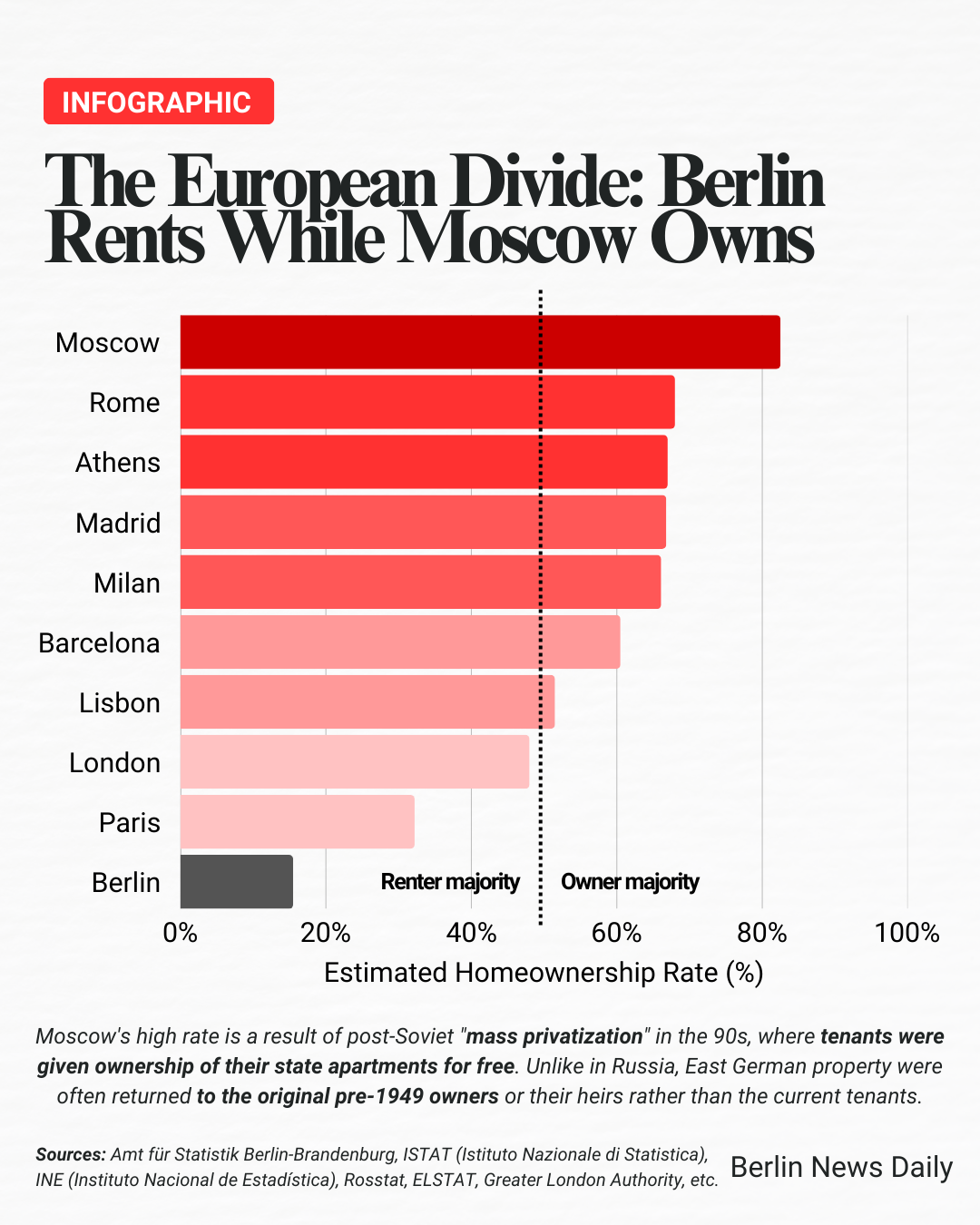
84% of Berliners rent. 82% of Muscovites own. Data shows a staggering disparity in how Europeans live.
🚃 Fun Fact: Berlin’s S-Bahn celebrated its 100th anniversary in 2024 – the first electric S-Bahn train ran on August 8, 1924, and a century later the system carries over 1.5 million riders on an average weekday.
👋 That's a wrap! Thank you for reading.
Got feedback? Write us at news@berlindaily.org.
☕ Enjoying the read? Support Berlin News Daily with a Coffee.